
Ingredient file // Grain
Barley Flour
A digestible starch, not a cholesterol fix
Barley flour is ground barley grain, mostly starch with some protein and a little beta-glucan fiber. In dog food it supplies digestible energy and binds kibble or thickens gravy. Its blood sugar and cholesterol claims outrun the dog data.
- What it is
- Barley grain, usually with the hull removed, milled into a fine flour that is mostly starch.
- Made from
- Barley kernels, hulled or hull-less varieties
- Main job
- Digestible starch and binding
- Typical amount
- Not published; dog trials fed 10 to 40%
- Watch for
- Contains gluten; avoid for gluten-sensitive dogs
- Not the same as
- Pearled barley or barley grass
Straight answer
Is Barley Flour safe for dogs?
Count it as starch and read past it
In a canned food, barley flour usually sits behind the meat, broth and vegetables, thickening the gravy. Read it as a starch, not as a fiber or heart ingredient, and ignore any cholesterol claim on the label. Skip it only for a dog that needs a gluten-free diet.
- Why it is in the food
- Digestible starch and binding
- How common
- Listed by 2 of the 3,205 foods we track
Our read // In our catalog
In 1 of every 1,603 foods we track
Share of foods that list it
<1%
2 of the 3,205 foods with an ingredient list on file, from 2 brands. All wet dog food.
Each square is 1% of the catalog
Where it sits on the label
Median position 10. In the top five of 0 foods, so it is usually a supporting ingredient.
Above the salt
Almost always listed before the salt, so there is more of it than a pinch.
Who leans on it
50%
of the foods that list it are from Fromm. 2 brands use it in total.
What it is
How it is made
Barley flour is made by roller milling the grain. Rollers crack the kernel and sifters sort the pieces: the starchy center becomes flour, and the fiber-rich outer layers leave as shorts and bran.1,6
- 01 // Source Barley kernels Hulled or hull-less grain. Hull-less varieties carry about half the fiber of hulled barley.
- 02 // Process Hull removed Removing the hull, grinding and breaking the bran layer all make barley more digestible for animals.
- 03 // Process Roller milled Rollers crack the kernel into flour streams, shorts and bran. In one lab mill, shorts were about half the yield.
- 04 // Process Sifted In a lab mill study of two hull-less varieties, one break-flour stream carried 0.8% beta-glucan, against about 7.2% in bran.
- 05 // Output Barley flour A fine powder that is mostly starch. The starchiest lab-milled flour stream reached about 82% starch.
What is in it
Composition, dry matter
60
% starch
The average starch in barley grain on a dry basis. It is an energy and binding ingredient first; protein and fiber are minor.
Why it is in the bag
What the manufacturer gets
-
01
Digestible energy
Barley is about 60% starch. In extruded dog diets with a flour as the main carbohydrate, barley included, more than 99% of the starch was digested.1,2
-
02
Binds and thickens
Heated starch swells and sets, which holds kibble together and thickens canned gravy. Suppliers sell barley flour as a binder for extrusion and baking.10
-
03
A grain swap for rice
In an 8-beagle trial, a barley diet digested at 88.81% of dry matter against 92.45% for rice, with similar amino acid digestibility except methionine.4
How much A 16-dog trial fed barley at 10, 20 and 40% of the diet without hurting digestibility; another trial's authors advised against diets above 50% barley.2,3
Our read // The claims
What the evidence supports
Strong: controlled studies in dogs agree. Some: small or mixed dog data. Thin: mechanism or lab work only. None: nothing, or the evidence points the other way.
-
Brands say
An easy-to-digest carbohydrate for dogs
Evidence
- Strong
- Some
- Thin
- None
The starch is well digested: more than 99% in a trial of six extruded flour diets, barley included. But barley gave the loosest stools there, and the lowest dry matter digestibility of four grains in an 8-beagle trial, 88.81% vs 91.6 to 93% for rice, corn and brown rice.2,4
-
Brands say
Slow-release energy that steadies blood sugar
Outruns the evidence
Evidence
- Strong
- Some
- Thin
- None
In a 15-dog crossover, diabetic dogs had steadier glucose on a pea and barley diet than on corn. In 16 healthy dogs, barley up to 40% of the diet did not improve post-meal glucose.3,5
-
Brands say
Natural fiber that supports digestive health
Outruns the evidence
Evidence
- Strong
- Some
- Thin
- None
Suppliers sell it this way. When barley flour was the main carbohydrate, stools were consistently looser and wet feces tended to be heaviest, short of significance. The cited trials measured digestibility and feces and found no gut benefit.2,3,10
-
Owners say
Barley beta-glucan lowers a dog's cholesterol
Outruns the evidence
Evidence
- Strong
- Some
- Thin
- None
In a 16-dog trial, barley at 10 to 40% of the diet did not lower plasma cholesterol. Flour carries little beta-glucan: one lab-milled break-flour stream had 0.8%, against about 7.2% in bran.3,6
-
Owners say
Grains like barley cause food allergies
Outruns the evidence
Evidence
- Strong
- Some
- Thin
- None
Among 297 dogs with proven food reactions, barley was the trigger in a single dog. Beef, dairy, chicken and wheat led the list, and those counts may largely reflect what dogs were fed.7
Straight answers
What owners ask
-
Q01
Is it just filler?
No, it's starchIt supplies energy, with starch digestion above 99% in extruded dog diets, and helps hold the food together. Dogs have no set carbohydrate requirement, so it is optional, but it is not empty.2,4
-
Q02
Is barley gluten-free?
NoBarley contains gluten, like wheat and rye. Most dogs handle it fine, but Border Terriers with a gluten-triggered movement disorder all improved on a strict gluten-free diet, 5 of 5 in one study.8,9
-
Q03
Is it better than rice?
About equalIn an 8-beagle trial, rice digested slightly better, 92.45% vs 88.81% of dry matter, while amino acid digestibility matched except for methionine. Neither grain has a proven health edge.4
-
Q04
Why is it in wet food?
To thickenFlour starch swells when heated in water, so a small amount thickens gravy and binds chunks in the can. In wet food it is a texture ingredient more than a nutrient.
Who uses it
Brands, best sellers and the company it keeps
Top brands, by foods that list it
Foods that list it / all the brand's recipes we track.
Usually listed with, share of the foods that list it
- Dried Egg Product 100%
- Beef 50%
- Beef Broth 50%
- Pork Broth 50%
- Potatoes 50%
- Beef Liver 50%
- Carrots 50%
- Tomato Paste 50%
- Tapioca Starch 50%
- Pork 50%
- Trout 50%
- Vegetable Broth 50%
On the shelf
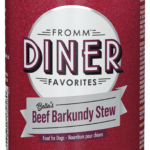
Foods that list Barley Flour
2 foods in our catalog list it, highest on the label first.

Sources
What we read
Checked October 25, 2026.
- 1 Barley grain
- 2 Evaluation of selected high-starch flours as ingredients in canine diets
- 3 Fish Oil and Barley Supplementation in Diets for Adult Dogs: Effects on Lipid and Protein Metabolism, Nutrient Digestibility, Fecal Quality, and Postprandial Glycemia
- 4 Nutritional value of common carbohydrate sources used in pet foods
- 5 Effects of pea with barley and less-processed maize on glycaemic control in diabetic dogs
- 6 Distribution of β-Glucan, Phenolic Acids, and Proteins as Functional Phytonutrients of Hull-Less Barley Grain
- 7 Critically appraised topic on adverse food reactions of companion animals (2): common food allergen sources in dogs and cats
- 8 The Clinical and Serological Effect of a Gluten-Free Diet in Border Terriers with Epileptoid Cramping Syndrome
- 9 Eating, Diet, & Nutrition for Celiac Disease
- 10 Barley Flour