
Ingredient file // Flavor
Beef Flavor
A beef seasoning, not a source of beef
Beef flavor is usually beef organs broken down by enzymes and heat into a concentrated taste, then sprayed on in small amounts. Its job is to get the dog to eat the food. It adds next to nothing nutritionally.
Role in the food Does a job- What it is
- A concentrated beef taste, usually beef tissue broken down with enzymes and heat, added to food in small amounts.
- Made from
- Beef organs and tissue, broken down by enzymes
- Main job
- Makes food taste of beef
- Typical amount
- Palatants: 0.5 to 2% as powder, 1 to 3% liquid
- Watch for
- Dogs with a diagnosed beef allergy
- Not the same as
- Beef or beef meal
Straight answer
Is Beef Flavor safe for dogs?
Read it as seasoning, not as beef
Beef flavor late in the list is a seasoning. It tells you the food tastes of beef, not that it contains much of it. Look higher up the list for the protein that actually feeds the dog, and skip the product if your dog has a beef allergy.
- Why it is in the food
- Makes food taste of beef
- How common
- Listed by 9 of the 3,205 foods we track
Our read // In our catalog
In 1 of every 356 foods we track
Share of foods that list it
<1%
9 of the 3,205 foods with an ingredient list on file, from 4 brands. 6 dry dog food, 3 dog food topper.
Each square is 1% of the catalog
Where it sits on the label
Median position 9. In the top five of 0 foods, so it is usually a supporting ingredient.
Above the salt
Listed before the salt in 67% of foods. In the rest it is under about 1% of the recipe.
Price per lb
Median of the cheapest bag price across 6 priced foods, 67% above the catalog. The price is the food's, not the ingredient's.
Who leans on it
56%
of the foods that list it are from The Honest Kitchen. 4 brands use it in total.
What it is
How it is made
Flavor makers take clean beef organs and break them down into a concentrated taste. Pet food uses it because dry food is less attractive to dogs than moist food, and flavor closes that gap.4,5
- 01 // Source Beef organs Clean, unrendered parts such as lungs, spleen, kidneys, liver, blood, stomachs and intestines.
- 02 // Process Enzyme breakdown Proteases and lipases cut proteins and fats into small peptides, free amino acids and fatty acids.
- 03 // Process Heated with sugars The Maillard reaction turns amino acids and sugars into meaty, roasted aroma compounds such as pyrazines and furans.
- 04 // Output Liquid or powder A palatant sprayed onto dry food, about 0.5 to 2% as a powder or 1 to 3% as a liquid.
What is in it
Composition, as fed
0.5-2
% of kibble
The usual dose of a powdered palatant sprayed on dry food. At that level beef flavor adds taste, not protein you could count.
Why it is in the bag
There for the taste, not for beef nutrition
- Main nutrition
- Supporting nutrient
- Does a job
- Mostly filler
Beef flavor makes the food taste of beef so the dog eats it. Dry foods are the least palatable format, which is why makers add palatants, usually 0.5 to 2% as a powder or 1 to 3% as a liquid. Ingredient lists run by weight, and at that dose beef flavor likely adds taste, not protein worth counting. It also lets the bag name beef.1,4
-
01
Gets dogs to eat kibble
Dry food is less attractive to dogs than moist food, so palatants get sprayed onto it. In a patent's 25-dog two-pan test, dogs preferred food coated with poultry liver hydrolysate.4
-
02
Puts beef on the bag
The flavor rule sets no minimum. Any listed ingredient that supplies the taste, digest included, lets the bag say beef flavor, as long as flavor is printed as prominently as beef.1,3
-
03
Beef ranks high with dogs
A 1974 study ranked beef above lamb and chicken, and a 1978 study found dogs liked beef and pork about equally, both above chicken and lamb. Brands pick the taste that sells.4
How much Palatants usually make up 0.5 to 2% of dry food as powders, or 1 to 3% as liquids, sprayed onto the kibble.4
Our read // The claims
What the evidence supports
Strong: controlled studies in dogs agree. Some: small or mixed dog data. Thin: mechanism or lab work only. None: nothing, or the evidence points the other way.
-
Brands say
Dogs like the taste of beef best
Evidence
- Strong
- Some
- Thin
- None
A 1974 study ranked beef first, ahead of lamb and chicken. A 1978 study found beef and pork level, both above chicken and lamb. Both compared meats, not a flavoring sprayed on kibble.4
-
Brands say
Flavor coating makes dogs eat their food
Evidence
- Strong
- Some
- Thin
- None
In a patent's 25-dog two-pan test, dogs preferred food coated with poultry liver hydrolysate, not a beef palatant. Two-pan tests record which bowl a dog picks over minutes, not whether it eats better for months or is healthier.4
-
Vets say
Beef flavor can set off a dog's beef allergy
Evidence
- Strong
- Some
- Thin
- None
Beef was the most reported food allergen, in 102 of 297 dogs with proven reactions. No study has fed beef-allergic dogs a flavor-sized dose of beef, so the risk at that dose is unmeasured.6
-
Owners say
Beef flavor means there is beef in the food
Outruns the evidence
Evidence
- Strong
- Some
- Thin
- None
The flavor rule has no minimum. A beef flavor food needs only enough beef to taste, under 3%, and the named flavor does not have to come from beef meat. A digest or by-product counts.1,2,3
Straight answers
What owners ask
-
Q01
Is it just filler?
No, it's seasoningFiller means bulk. Beef flavor goes in at a couple of percent or less and supplies taste, not calories or protein worth counting. Its job is getting the dog to eat everything else.4
-
Q02
Is 'beef flavor' the same as 'with beef'?
NoA 'with beef' claim needs at least 3% beef. A flavor claim needs only an ingredient that gives the taste, with the word flavor printed as large as the word beef.1,3
-
Q03
Is artificial beef flavor different?
Different sourceSuppliers sell artificial powdered beef flavor for pet products, a mixture of flavor materials whose components one supplier keeps as a trade secret. Plain beef flavor typically comes from digested beef tissue instead.4,8
Who uses it
Brands, best sellers and the company it keeps
Top brands, by foods that list it
Foods that list it / all the brand's recipes we track.
Amazon best sellers that list it
Rank on Amazon's dog food best seller list, checked October 2026.
Usually listed with, share of the foods that list it
- Beef 56%
- Beef Liver 56%
- Flaxseed 56%
- Peas 44%
- Natural Flavor 33%
- Salt 33%
- Potatoes 33%
- Lentils 33%
- Eggs 33%
- Dicalcium Phosphate 33%
- Yeast Extract 22%
- Sweet Potato Powder 22%
On the shelf
Foods that list Beef Flavor
9 foods in our catalog list it, highest on the label first.
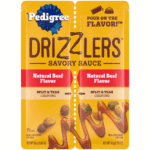 PedigreePedigree DRIZZLERS Wet Dog Savory Sauce, Natural Beef Dog Food Topper
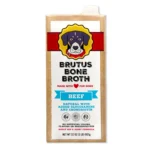 Brutus BrothBrutus Broth Brutus Bone Broth for Dogs - Beef Dog Food Topper
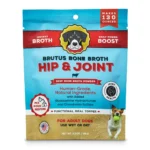 Brutus BrothBrutus Broth Hip & Joint Meal Topper Hip & Joint Mega Pack Dog Food Topper
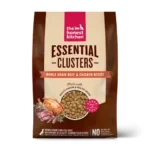 The Honest KitchenThe Honest Kitchen Whole Grain Beef & Chicken Essential Clusters Dry Dog Food
 The Honest KitchenThe Honest Kitchen Whole Grain Beef & Oat Recipe Whole Food Clusters Dry Dog Food
 Kibbles n BitsKibbles n Bits Bacon & Steak Flavor Dry Dog Food
Show 3 more
 The Honest KitchenThe Honest Kitchen Grain-Free Beef Recipe Whole Food Clusters Dry Dog Food
 The Honest KitchenThe Honest Kitchen Grain Free Beef Whole Food Clusters for Small Breeds Dry Dog Food
 The Honest KitchenThe Honest Kitchen Whole Food Clusters Grain Free Beef & Chicken Protein Plus Clusters Dry Dog Food
Leaving it out
Foods without beef
For owners who skip beef: popular dry foods priced like the ones that list it ($4.12 to $8.23 per lb), with no beef on the label.
 OrijenOrijen Original Grain-Free Dry Dog Food
 The Honest KitchenThe Honest Kitchen Whole Grain Chicken & Oat Recipe Whole Food Clusters Dry Dog Food
 Hill'sHill’s Science Diet Puppy Chicken & Brown Rice Recipe No Corn, Wheat, Soy Dry Dog Food
 Solid GoldSolid Gold Mighty Mini Toy & Small Breed Chicken, Chickpea & Pumpkin Recipe Grain-Free Dry Dog Food
 Royal CaninRoyal Canin Veterinary Gastrointestinal Puppy Dry Dog Food
 Royal CaninRoyal Canin Veterinary Glycobalance Dry Dog Food
 GatherGather Endless Valley Vegan Recipe for Adult Dogs Dry Dog Food
 LotusLotus Oven Baked Small Bites Chicken Recipe Senior Dry Dog Food
Checked against the ingredient list we store for each food. Labels change, so read the bag before you buy.
Sources
What we read
Checked October 1, 2026.
- 1 Reading Labels
- 2 Dog and Cat Foods
- 3 Pet food labels: Cracking the code (Proceedings)
- 4 Dry Pet Food Flavor Enhancers and Their Impact on Palatability: A Review
- 5 Modern Palatant Strategies in Dry and Wet Pet Food: Formulation Technologies, Patent Innovations, and Market Evolution
- 6 Critically appraised topic on adverse food reactions of companion animals (2): common food allergen sources in dogs and cats
- 7 Critically appraised topic on adverse food reactions of companion animals (5): discrepancies between ingredients and labeling in commercial pet foods
- 8 PC-0125 Safety Data Sheet (SDS)