
Ingredient file // Animal protein
New Zealand King Salmon
A rich, fatty fish, not a joint treatment
New Zealand King salmon is farmed Chinook with a very high oil content, used here raw and freeze-dried. It gives the dog animal protein, plenty of fat and real EPA and DHA, in amounts the label does not disclose.
- What it is
- Farmed Chinook salmon from New Zealand, used raw and freeze-dried as a fatty animal protein.
- Made from
- Sea- and lake-farmed Chinook salmon
- Main job
- Animal protein, fat, omega-3s
- Typical amount
- Not published
- Watch for
- Raw bacteria; freeze-drying is not a kill step
- Not the same as
- Salmon oil or Atlantic salmon
Straight answer
Is New Zealand King Salmon safe for dogs?
Count it as protein and fat, not medicine
When salmon sits behind lamb and lamb organs, it is real fish in a lamb-based food. Count it as protein and fat, and treat the omega-3 as a bonus of unknown size. For an arthritic dog, ask your vet about a measured fish oil dose instead. Handle the food like raw meat.
- Why it is in the food
- Animal protein, fat, omega-3s
- How common
- Listed by 1 of the 3,205 foods we track
Our read // In our catalog
In 1 of every 3,205 foods we track
Share of foods that list it
<1%
1 of the 3,205 foods with an ingredient list on file, from 1 brand. All freeze-dried dog food.
Each square is 1% of the catalog
Where it sits on the label
Median position 2. In the top five of 1 food, so it is usually a main ingredient.
Above the salt
Almost always listed before the salt, so there is more of it than a pinch.
Price per lb
Median of the cheapest bag price across 1 priced foods, 1054% above the catalog. The price is the food's, not the ingredient's.
Who leans on it
100%
of the foods that list it are from K9 Natural. 1 brand use it in total.
What it is
How it is made
King salmon is the only salmon species farmed in New Zealand, a small slice of world salmon sold on its high oil content. Its main producer sends leftover raw material to pet food instead of rendering.3,4,5,10
- 01 // Source Farmed King salmon Raised in Marlborough Sounds sea farms and Mackenzie Basin lakes and canals on pellets of fishmeal, fish oil and plant proteins.
- 02 // Process Filleted by hand Fillets are graded, trimmed and pin-boned by hand.
- 03 // Process Leftovers redirected Raw material left after filleting, once sent to rendering, now goes into the producer's own pet food line.
- 04 // Process Freeze-dried raw Frozen and dried under vacuum without cooking. That preserves the food but is not a bacterial kill step.
- 05 // Output Freeze-dried salmon A light, shelf-stable raw ingredient, blended in this recipe with lamb, lamb organs and green-lipped mussel.
What is in it
Composition, dry matter
52
% fat
Fat in New Zealand King salmon fillet on a dry basis. Fat outweighs protein, so this fish adds calories as much as protein.
Why it is in the bag
What the manufacturer gets
-
01
Animal protein and energy
Dry raw Chinook is about 70% protein, and New Zealand King fillet about 45% protein and 52% fat, so it adds both protein and calories to a meat-based food.1,2
-
02
Ready-made EPA and DHA
Fish supply long-chain omega-3s directly. Raw Chinook holds about 1.95 g EPA plus DHA per 100 g, which the flaxseed on the same label does not provide.1
-
03
A rare, named species
King salmon is 0.7% of the world's salmon, and its producer markets it on a very high oil content and fillets graded, trimmed and pin-boned by hand.4
-
04
Leftovers find a buyer
New Zealand King Salmon built a pet food line from leftover raw material that would otherwise go to rendering, which it calls a low-return disposal route.5
How much No source publishes how much salmon a recipe holds; the arthritis trial food that helped dogs carried 3.5% fish oil omega-3.7
Our read // The claims
What the evidence supports
Strong: controlled studies in dogs agree. Some: small or mixed dog data. Thin: mechanism or lab work only. None: nothing, or the evidence points the other way.
-
Brands say
Salmon is rich in omega-3s
Evidence
- Strong
- Some
- Thin
- None
Raw Chinook carries about 1 g EPA and 0.94 g DHA per 100 g, nearly 7% of its dry matter. In a New Zealand King salmon trial, two 120 g servings a week supplied 0.82 g long-chain omega-3 a day.1,6
-
Brands say
Salmon's omega-3s ease stiff, arthritic joints
Outruns the evidence
Evidence
- Strong
- Some
- Thin
- None
In a 38-dog, 90-day trial of a food with 3.5% fish oil omega-3, peak vertical force on the sore leg improved in 82% of dogs against 38% on a control food. No trial has tested salmon meat, and this food's salmon share is undisclosed.7
-
Owners say
Fish is a safe pick for allergic dogs
Outruns the evidence
Evidence
- Strong
- Some
- Thin
- None
Fish caused 5 of 297 proven food reactions, against 102 for beef. Low counts may reflect how rarely dogs ate fish, and a lamb-led recipe with mussel is not an elimination diet.8
-
Owners say
New Zealand King salmon is wild-caught
Outruns the evidence
Evidence
- Strong
- Some
- Thin
- None
King salmon is the only salmon species farmed in New Zealand, in Marlborough Sounds sea farms and Mackenzie Basin canals, on pellets of fishmeal, fish oil and plant and animal proteins. The branded fish is farmed, not a wild catch.3,4
-
Critics say
Salmon carries too much mercury for dogs
Outruns the evidence
Evidence
- Strong
- Some
- Thin
- None
FDA places salmon in its Best Choice group, its lowest-mercury tier for people who eat fish weekly.13
Straight answers
What owners ask
-
Q01
Is it just filler?
NoDry raw Chinook is about 70% protein and 37% fat, and New Zealand King fillet is fattier still. It supplies protein, energy and omega-3s, which is the opposite of filler.1,2
-
Q02
Can it give my dog salmon poisoning?
Very unlikelySalmon poisoning comes from a fluke in raw salmonids, and US cases are limited to the coastal Pacific Northwest. This fish is farmed in New Zealand, far outside that range.4,12
-
Q03
Does freeze-drying kill the bacteria?
Not reliablyFreeze-drying is preservation, not bacterial control. An Ontario Veterinary College blog says it probably makes no difference for Salmonella and Listeria, and a raw pet food study found freezing and drying may reduce bacteria but not eradicate them.10,11
Who uses it
Brands, best sellers and the company it keeps
Top brands, by foods that list it
Foods that list it / all the brand's recipes we track.
Usually listed with, share of the foods that list it
- Lamb 100%
- Lamb Tripe 100%
- Lamb Lung 100%
- Lamb Liver 100%
- Lamb Kidney 100%
- Lamb Heart 100%
- Flaxseed Flakes 100%
- Carrots 100%
- New Zealand Green-Lipped Mussel 100%
On the shelf
Foods that list New Zealand King Salmon
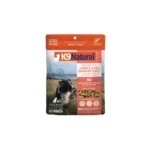
1 food in our catalog lists it, highest on the label first.
Sources
What we read
Checked October 25, 2026.
- 1 Fish, salmon, chinook, raw (FDC ID 173688)
- 2 Salmon king fillet skin & bones removed fresh baked without fat no salt added New Zealand
- 3 King salmon
- 4 Finest King salmon
- 5 Value Add Salmon
- 6 The effect of consuming farmed salmon compared to salmon oil capsules on long chain omega 3 fatty acid and selenium status in humans
- 7 Evaluation of the effects of dietary supplementation with fish oil omega-3 fatty acids on weight bearing in dogs with osteoarthritis
- 8 Critically appraised topic on adverse food reactions of companion animals (2): common food allergen sources in dogs and cats
- 9 Get the Facts! Raw Pet Food Diets can be Dangerous to You and Your Pet
- 10 Freeze dried vs fresh vs frozen raw pet foods
- 11 Contamination factors associated with surviving bacteria in Thai commercial raw pet foods
- 12 Salmon Poisoning Disease in Dogs
- 13 Advice about Eating Fish