
Ingredient file // Other
Xanthan
A trace thickener for gravy, not a fiber source
Xanthan is a gum that bacteria make when they ferment sugar, purified into a powder. In wet food it thickens gravy and binds the loaf, and it largely passes through the dog undigested.
Role in the food Does a job- What it is
- A powdered gum made by bacteria fermenting sugar, then purified, used to thicken and stabilize wet foods.
- Made from
- Glucose or sucrose fermented by Xanthomonas campestris bacteria
- Main job
- Thickens gravy and binds pâté
- Typical amount
- About 0.5% in a tested canned pâté recipe
- Watch for
- Loose stools in beagles fed large test doses
- Not the same as
- Xylitol, the sweetener toxic to dogs
Straight answer
Is Xanthan safe for dogs?
Read past it to the meat and water
Expect xanthan near the end of a wet food list, after the meats, organs and water, often beside guar or another gum. That placement is normal and tells you the recipe uses a gravy or loaf. Judge the food by its proteins, and ignore any gut-health claim built on the gum.
- Why it is in the food
- Thickens gravy and binds pâté
- How common
- Listed by 1 of the 3,205 foods we track
Our read // In our catalog
In 1 of every 3,205 foods we track
Share of foods that list it
<1%
1 of the 3,205 foods with an ingredient list on file, from 1 brand. All wet dog food.
Each square is 1% of the catalog
Where it sits on the label
Median position 18. In the top five of 0 foods, so it is usually a minor ingredient.
Who leans on it
100%
of the foods that list it are from Eukanuba. 1 brand use it in total.
What it is
How it is made
Xanthan is a made-to-order food additive, not a leftover. Plants grow Xanthomonas campestris bacteria on sugar in aerated tanks and collect the gum the bacteria release into the broth.1,8
- 01 // Source Sugar and bacteria A medium of glucose or sucrose, a nitrogen source, phosphate and trace minerals is seeded with Xanthomonas campestris.
- 02 // Process Aerated fermentation The bacteria grow in submerged, aerated tanks and release the gum into the culture broth.
- 03 // Process Alcohol precipitation With the cells removed, ethanol or isopropyl alcohol pulls the gum out. US rules cap leftover isopropyl alcohol at 750 ppm.
- 04 // Process Dried and milled The gum is dried and ground. Recent batches still lost 9.2 to 15% of their weight on drying.
- 05 // Output Xanthan gum powder A food grade powder, sold as a sodium, potassium or calcium salt, ready to weigh into wet food.
What is in it
Composition, dry matter
7-16
% ash
Ash in recent industry batches, on a moisture-free basis. Nearly all the rest is a sugar polymer that digestive enzymes do not break down.
Why it is in the bag
There to thicken gravy, not to feed
- Main nutrition
- Supporting nutrient
- Does a job
- Mostly filler
Makers add xanthan to wet food to thicken the batter and hold water in the loaf after canning. A tested pâté used 0.5%, and labels list ingredients by weight, so it often sits far down the list, after the meats and water. Digestive enzymes do not break it down and gut bacteria ferment only part of it, so it likely adds no useful nutrition. It is a working additive, not filler.1,6,10
-
01
Thickens the batter
In a canned pâté test, 0.5% xanthan plus 0.5% guar made a batter that flowed 2.94 cm in 30 seconds, against 23.64 cm for a dextrose control.6
-
02
Holds water in the loaf
After retorting at 121 °C, the xanthan and guar pâté and the locust bean gum pâté had the lowest expressible moisture, about 16 to 17%, against about 50% for dextrose alone.6
-
03
Works with other gums
Xanthan with guar or another galactomannan forms firm, rubbery gels, and suppliers note thickeners act more strongly in combination, so recipes pair them at low doses.6,7
How much A Kansas State canned pâté study used 0.5% xanthan with 0.5% guar, a total gum load of 1% of the batter.6
Our read // The claims
What the evidence supports
Strong: controlled studies in dogs agree. Some: small or mixed dog data. Thin: mechanism or lab work only. None: nothing, or the evidence points the other way.
-
Brands say
Thickens gravy and holds wet food together
Evidence
- Strong
- Some
- Thin
- None
This is food chemistry, measured directly. In a canned pâté test, xanthan with guar gave a far thicker batter and a firmer loaf, 14.87 N against about 8.75 N for dextrose controls. It says nothing about nutrition.6
-
Brands say
It passes through the dog largely undigested
Evidence
- Strong
- Some
- Thin
- None
Digestive enzymes do not break it down. In rats fed labeled gum, at most 15% of the label became carbon dioxide in 100 hours, so gut bacteria use a little. In a dog fecal test it was among the least fermented of 14 fibers.1,2,4
-
Owners say
Xanthan gum gives dogs diarrhea
Outruns the evidence
Evidence
- Strong
- Some
- Thin
- None
At test doses, yes. Beagles fed 1 to 2 g per kg of body weight a day had diarrhea, and stools were loose at 1 g in a 107-week study but normal at 0.37 g. No study ties wet food amounts to it.2
-
Brands say
A prebiotic fiber that feeds good gut bacteria
Outruns the evidence
Evidence
- Strong
- Some
- Thin
- None
The dog evidence points the other way. In a dog fecal test it was among the least fermented of 14 fibers, and in an 18-dog lab study only 1 of 6 small-dog donors responded. A rival prebiotic maker funded that study.4,5
-
Critics say
A synthetic additive that is unsafe for dogs
Outruns the evidence
Evidence
- Strong
- Some
- Thin
- None
Beagles fed up to 1 g per kg of body weight daily for 107 weeks showed no effects on survival, weight gain or organs. EU approval for dogs is pending only because the maker asked for a higher dog maximum than EFSA set.2,3
Straight answers
What owners ask
-
Q01
Is it just filler?
No, it's textureFiller implies bulk with no job. Xanthan goes in at a fraction of a percent and adds almost nothing a dog digests. Its job is to thicken gravy and stop pâté from weeping liquid.1,6
-
Q02
Is xanthan the same as xylitol?
NoThe names sound alike, the molecules do not. Xylitol is a sugar alcohol sweetener that triggers a sharp insulin release and dangerous low blood sugar in dogs. Xanthan is a gum that dogs barely digest.1,9
-
Q03
Why is it near the end of the list?
Tiny amountsIngredients are listed by weight, and gums work at fractions of a percent; the tested pâté used 0.5%. Near the end, after the meats, organs and water, is exactly where it belongs.6
Who uses it
Brands, best sellers and the company it keeps
Top brands, by foods that list it
Foods that list it / all the brand's recipes we track.
Usually listed with, share of the foods that list it
- Water 100%
- Chicken 100%
- Pork Lung 100%
- Pork Liver 100%
- Chicken Liver 100%
- Lamb 100%
- Brown Rice 100%
- Rice Flour 100%
- Carrots 100%
- Tomatoes 100%
On the shelf
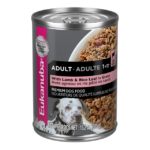
Foods that list Xanthan
1 food in our catalog lists it, highest on the label first.
Sources
What we read
Checked October 1, 2026.
- 1 Re-evaluation of xanthan gum (E 415) as a food additive
- 2 Xanthan gum (WHO Food Additives Series 21)
- 3 Commission Implementing Regulation (EU) 2026/538 of 11 March 2026 concerning the renewal of the authorisation of xanthan gum as a feed additive for all animal species other than cats, dogs and aquatic species
- 4 Dietary fiber for dogs: IV. In vitro fermentation of selected fiber sources by dog fecal inoculum and in vivo digestion and metabolism of fiber-supplemented diets
- 5 Effects of cRG-I Prebiotic Treatment on Gut Microbiota Composition and Metabolic Activity in Dogs In Vitro
- 6 The Effects of Select Hydrocolloids on the Processing of Pâté-Style Canned Pet Food
- 7 The role of emulsifiers and stabilizers in wet pet food
- 8 21 CFR 172.695 Xanthan gum
- 9 Paws Off Xylitol; It's Dangerous for Dogs
- 10 21 CFR 501.4 Animal food; designation of ingredients